


Thomas Merton’s France: A Virtual Pilgrimage
Updated: Apr 19
Oh, what a thing it is, to live in a place that is so constructed that you are forced, in spite of yourself, to be at least a virtual contemplative! (SSM, 42)
In the Spring of 2026, my wife and I travelled to the Pyrénées-Orientales and Midi-Pyrénées (Occitanie) regions of southwest France to explore the beauty and cultural richness of these locations but more specifically to trace the footsteps of Thomas Merton’s France. Merton was born in Prades, now a small bustling city in the shadow of the Canigou Massif. After raising young Tom on Long Island, New York, Merton’s father, Owen, an artist, would return to France; relocating them to the small, preserved medieval village of Saint-Antonin-Noble-Val. What follows is a brief visual essay, capturing some of the locations that Merton explicitly references in his 1948 autobiography, The Seven Storey Mountain. (All citations are from the Signet paperback first edition. All photographs by the author (c) 2026 unless otherwise noted.)
Prades
On the last day of January 1915, under the sign of the Water Bearer, in a year of a great war, and down in the shadows of some French mountains on the borders of Spain, I came into the world. (SSM, p. 9)

View of Canigou Massif from Vernet-Les-Bains
My father painted like Cézanne and understood the southern French landscape the way Cézanne did […] My father came to the Pyrenees because of a dream of his own… Father wanted to get some place where he could settle in France, and raise a family, and paint, and live on practically nothing, because we had practically nothing to live on. (p. 9, 11)

Owen Merton, Prades (191?). Courtesy of merton.org/owen
My father and mother came from the ends of the earth, to Prades, and though they came to stay, they stayed there barely long enough for me to be born and get on my small feet, and then they left again. And they continued and I began a somewhat long journey: for all three of us, one way and another, it is now ended. (p. 10)
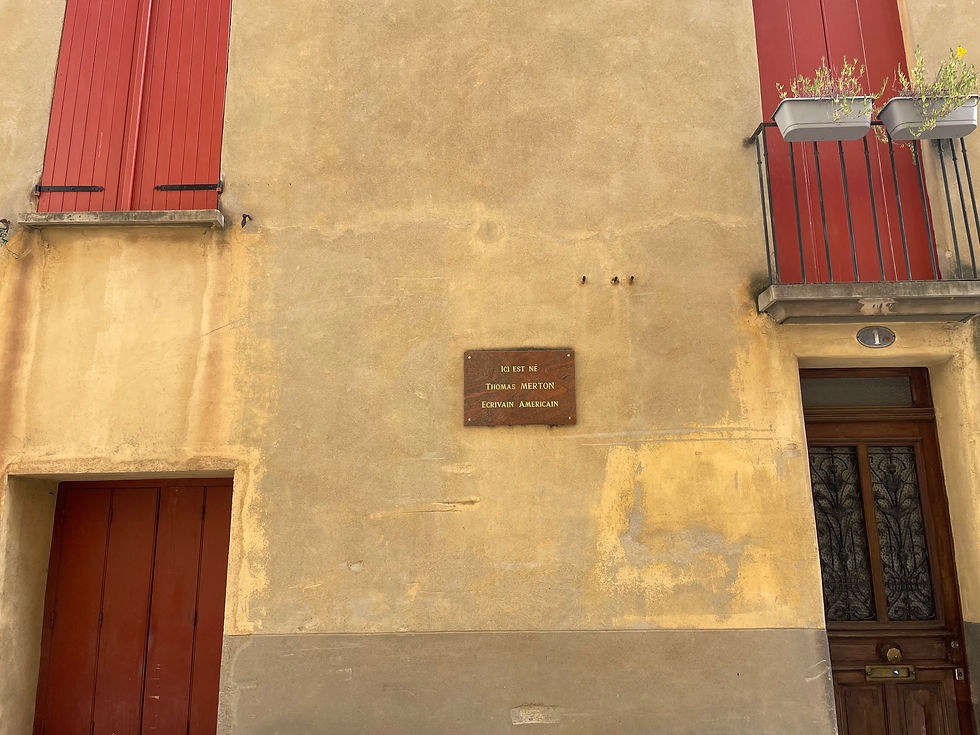
Rue du 4 Septembre, Prades
Mother would paint in the hills, under a large canvas parasol, and Father would paint in the sun, and the friends would drink red wine and gaze out over the valley at Canigou, and at the monastery on the slopes of the mountain. (p. 12)

Abbey of Saint-Martin-du-Canigou
There were many ruined monasteries in those mountains. My mind goes back with great reverence to the thought of those clean, ancient stone cloisters, those low and mighty rounded arches hewn and set in place by monks who have perhaps prayed me where I now am. St. Martin and St. Michael the Archangel, the great patron of monks, had churches in those mountains. Saint Martin-du-Canigou; Saint Michel-de-Cuxa. Is it any wonder I should have a friendly feeling about those places? (p. 12)

Cloister, Abbey of Saint-Martin-du-Canigou

Cloister, Abbey of Saint-Michel-de-Cuxa
St. Antonin-Noble-Val
It was an old, old town. Its history went back to the Roman days – which were the time of the martyred saint – its patron. (p. 40)

The town itself was a labyrinth of narrow streets […] Every street pointed more or less inward to the center of the town, to the church. (p. 41)

And then when Father began to make plans for building his house, we travelled all over the countryside looking at places, and also visiting villages where there might be good subjects for pictures. Thus I was constantly in and out of old churches, and stumbled upon the ruins of ancient chapels and monasteries. (p. 43)

Cistercian Abbey of Villelongue
Then…we went down into the plains to the south, and came to Albi, with the red cathedral of St. Cecilia frowning over the [river] Tarn like a fortress. (p. 43)

Cathedral of Saint Cecilia, Albi
…Father had already drawn up plans for the house we would build on the land he had now bought at the foot of Calvary. It would have one big room, which would be a studio and dining room and living room, and then upstairs there would be a couple of bedrooms. That was all. (p. 44)

*Out of respect for the present owners, images of Owen Merton's house are excluded
We traced out the foundation and Father and a workman began to dig. Then a water diviner came in and found us water and we had a well dug. Near the well Father planted two poplar trees – one for me, one for John Paul – and to the east of the house he laid out a large garden… (p. 44)

One of the poplar trees dedicated to Owen Merton's sons, now felled. The well has been removed.
…Father and I had gone out to see an old abandoned chapel that stood on the property… [that] now…was in ruins. And it had a beautiful thirteenth- or fourteenth-century window… Father bought the whole thing…and we eventually used the stones and the window and the door-arches…in building our house at St. Antonin.

It is sad…that we never lived in the house that Father built. But never mind! The grace of those days has not been altogether lost, by any means. (p. 65)

Saint-Antonin and the Aveyron River
Le Devot Christ: Perpignan
Thomas Merton's 1953 book on the Psalms, Bread in the Wilderness, incorporates stunning images of a 14th c. wood-carved Christ, an object of devotion for centuries. The chapel that houses Le Devot Christ was closed upon our arrival; the images of the interior are included here from the French Ministry of Culture.


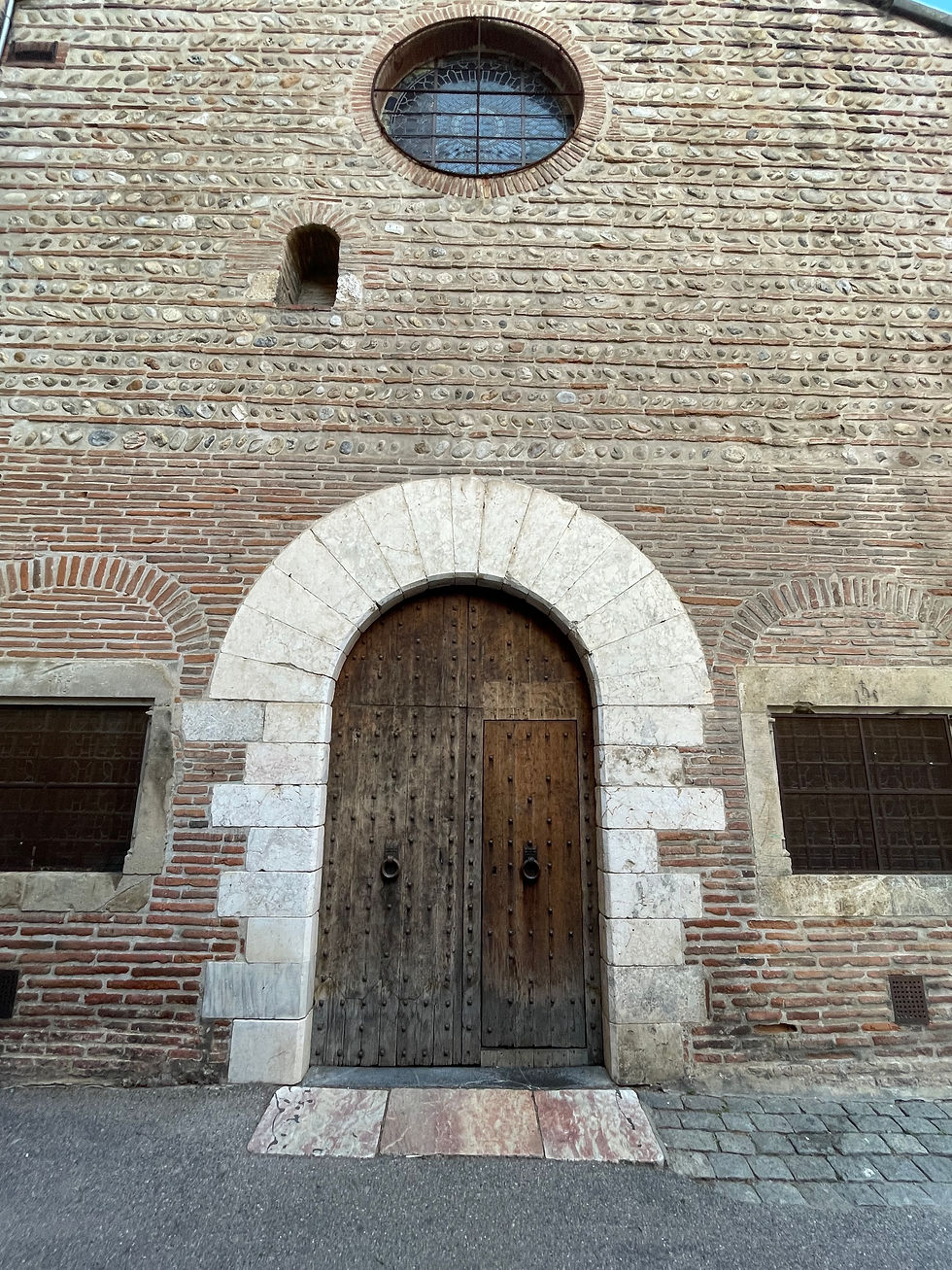
Cathedral of Saint John the Baptist, Perpignan. Le Devot Christ is located in a small chapel behind the cathedral.


Merton's 1966 Conjectures of a Guilty Bystander includes at one point a litany of praise for his French ancestry that is not only geographical, but deeply imaginal, and rooted in the richness of 12th c. French mystical theology. I include here Merton's nostalgic longing and remembering of his country of origin:
Again, the French angels: the tone and value of my own interior world! […]
It is…of great importance to me that I have known the narrow streets of Cordes (they are discovering there, now, places where the Albigensians hid in catacombs). It is important to me that I have walked the dusty road under the plane trees from St. Antonin to Caylus and from Caylus to Puylagarde: to have passed through the nondescript, dusty subprefecture of Caussade, and to have stood by the tower of the hanged men or on the fortified bridge of Cahors. Or lifted my eyes in the thin rain of a Sunday evening to look at the brick tower of Saint Jacques, by the Tarn bridge, in Montauban (hurrying back to the lycée). It is important for me forever to have stood in the ruined castles of Penne and Najac, or waited for a long time in the train by the rows of winebarrels below the bluff of Beziers, with the cathedral up on top. (How was such a citadel ever stormed, how did the Albigensians lose it?) It is important to have seen the jagged outline of the towers of Carcassonne against the evening sky. To have smelled the sun and the dust in the streets of Toulouse or Narbonne. There are times when I am mortally homesick for the South of France, where I was born. (CGB, pp. 185-86)

"the jagged outline of the towers of Carcassonne"

"the sun and the dust in the streets of Toulouse" - washed clean by the Spring rain

Vincent Bioulès, Le Canigou (2006). Céret Museum of Modern Art.
~ GRATIAS DEO ~


Comments