


A Litany for a Lost Lineage: Abbots Oderisius I & II
In August of 2009 I had the good fortune to travel to the Abruzzo region of central Italy to celebrate my second cousin’s First Communion. My family has deep roots in this area. My father was born there, and my mother’s family originates from a neighboring mountaintop community. The ceremony was conducted at the remarkable former abbey church of San Giovanni in Venere (Saint John in Venus, founded upon an ancient Roman temple to Venus, as was often the case for Benedictine foundations) dating to the tenth century, with origins in the sixth. The month of August in central Italy is famously hot and humid, and the church was quite full. To get some air, I wandered outside to admire the façade of the medieval abbey church and cloister. Upon turning to examine more closely a relief on the exterior, I felt the blood run out of my face. I was staring back at my own name – or a Latinized version of it. It was a funerary for a former monk: Abbot Oderisius.

A testament to the virtues ("moribus") of Abbot Oderisius, also a Cardinal, born in Collepietro (Abruzzo), who lived to the age of 60 (San Giovanni in Venere, photograph by the author; generous assistance with the translation from Dr. Emily Lord-Kambitsch)
Upon returning from the trip, I had work to do. Thanks to the wonders of the internet, I was able to glean that there was not one, but two Abbots Oderisius, who trace their immediate ancestry not to Italy, but to a medieval Burgundian landowning family who relocated to the Marsica region of Abruzzo around the tenth century. A nobleman of Frankish origins, Berardo, along with Hugh of Provence, relied on the nearby Benedictine monasteries of Farfa and Subiaco to build up their own regional political and ecclesiastical domain, thus launching a family dynasty that would last for three centuries. The “Berardinga,” or Counts of Marsi, would produce six saints, including two cardinals, several bishops, and at least two Benedictine abbots: Saint Oderisius de Marsi (d. 1105) and Oderisius di Sangro (d. 1137?).

Oderisius de Marsi was educated at the Benedictine monastic epicenter, the Abbey of Monte Cassino, in the nearby Lazio region of Italy, and made a Cardinal in 1059. He served as prior at Monte Cassino and later as its thirty-ninth abbot beginning in 1087. A scholar with an eye for architecture, Abbot Oderisius expanded the monastic complexes at both Monte Cassino and San Giovanni in Venere. At Monte Cassino, Oderisius apparently established a custom, where after a monk’s death, one of the locals in need would be fed in the monk’s stead for thirty days. Devoted to the souls of the deceased, the abbot began a liturgical tradition at Monte Cassino of praying for the dead with specific votive masses offered on Fridays.

Saint Oderisius de Marsi (feast day December 2). Buried in Monte Cassino. Sculpture by Francesco Queirolo, 1756 (Naples, San Severo Chapel)
Oderisius I exercised considerable political and ecclesial influence in his time, corresponding with the Byzantine emperor on behalf of crusading knights, for example. Oderisius di Sangro was involved in an entirely different level of ecclesiastical politics. Oderisius II also descended from the Counts of Marsi, and like his namesake, was educated at Monte Cassino, where he entered at a young age. Oderisius was later named “provost” (praepositus) at Monte Cassino, made a Cardinal in 1111 or 1112, and in 1123, elected abbot. Deeply entrenched in the papal controversies of his time, he was deposed as abbot and excommunicated by Pope Honorius II in 1126, only to regain favor with Pope Anacletus II, elected in 1130. Oderisius II died around 1137.

And yet another Oderisius II appears in the chronicles associated with the Abbey of San Giovanni in Venere. An Abbot Oderisius II of Collepietro, also a Cardinal, descended from the Counts of Valva (also of Abruzzo), significantly enlarged and rebuilt the abbey church around 1165. It was during his tenure that the abbey flourished, reaching its peak both financially and culturally. This is the "Oderisius" I encountered outside the abbey church that hot summer day.
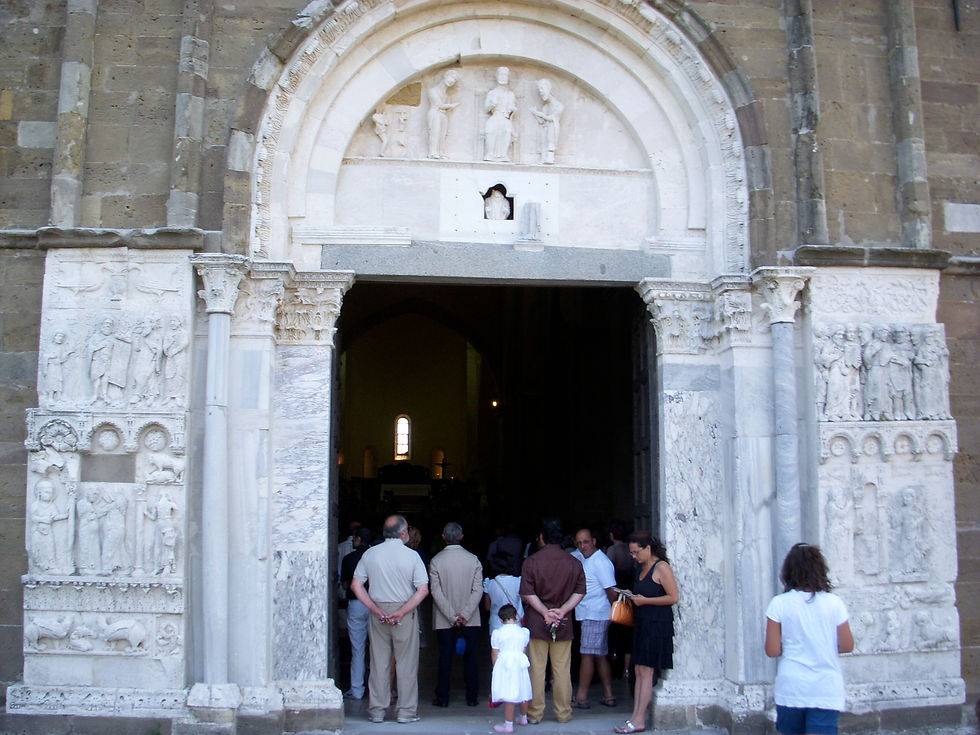
Portale Della Luna, Abbey Church of San Giovanni in Venere (photograph by the author)

Cloister, San Giovanni in Venere (photograph by the author)
How did I return to this, fifteen years later? Partially, it’s to tell a story that feels “forgotten” within my own ancestral lineage; but more so, it’s an attempt to explore – and potentially explain – my own monastic leanings and longings. Drawn to religious orders with tenth-and-twelfth century origins since my young adulthood, I ended up pursuing “monastic studies” in a graduate seminary and school of theology maintained by none other than Benedictine monks - my own American midwest version of “Monte Cassino.” It was only a few years after completing this program that I found myself staring face to face with “my” ancestral nom de monastique at San Giovanni. Not to mention my decades-long personal and scholarly dance with that most famous and controversial of American monks – a Trappist – Thomas Merton. Who knows what direct linkages connect us with our ancestors (however real or imagined they may be); however, it is through engaging in this type of genealogy-as-psychotherapy that perhaps the roots, shoots, and fruits - not to mention shadows - begin to reveal themselves to one personally. Surely, through this type of imaginal encounter with generations gone by, it might become possible to reclaim - and even redeem - some element of the past in service to the present and future.
In memory of Rev. Andrew D. Ciferni, O. Praem. (1942-2025) who reveled in his own Abruzzese ancestry
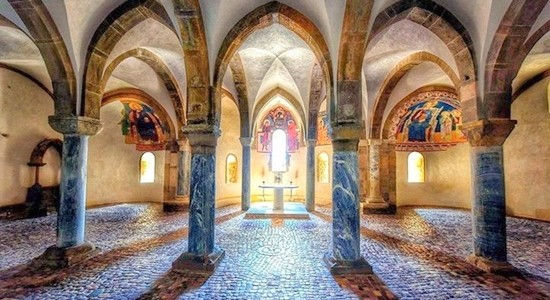
Crypt, San Giovanni in Venere Image


Comments